
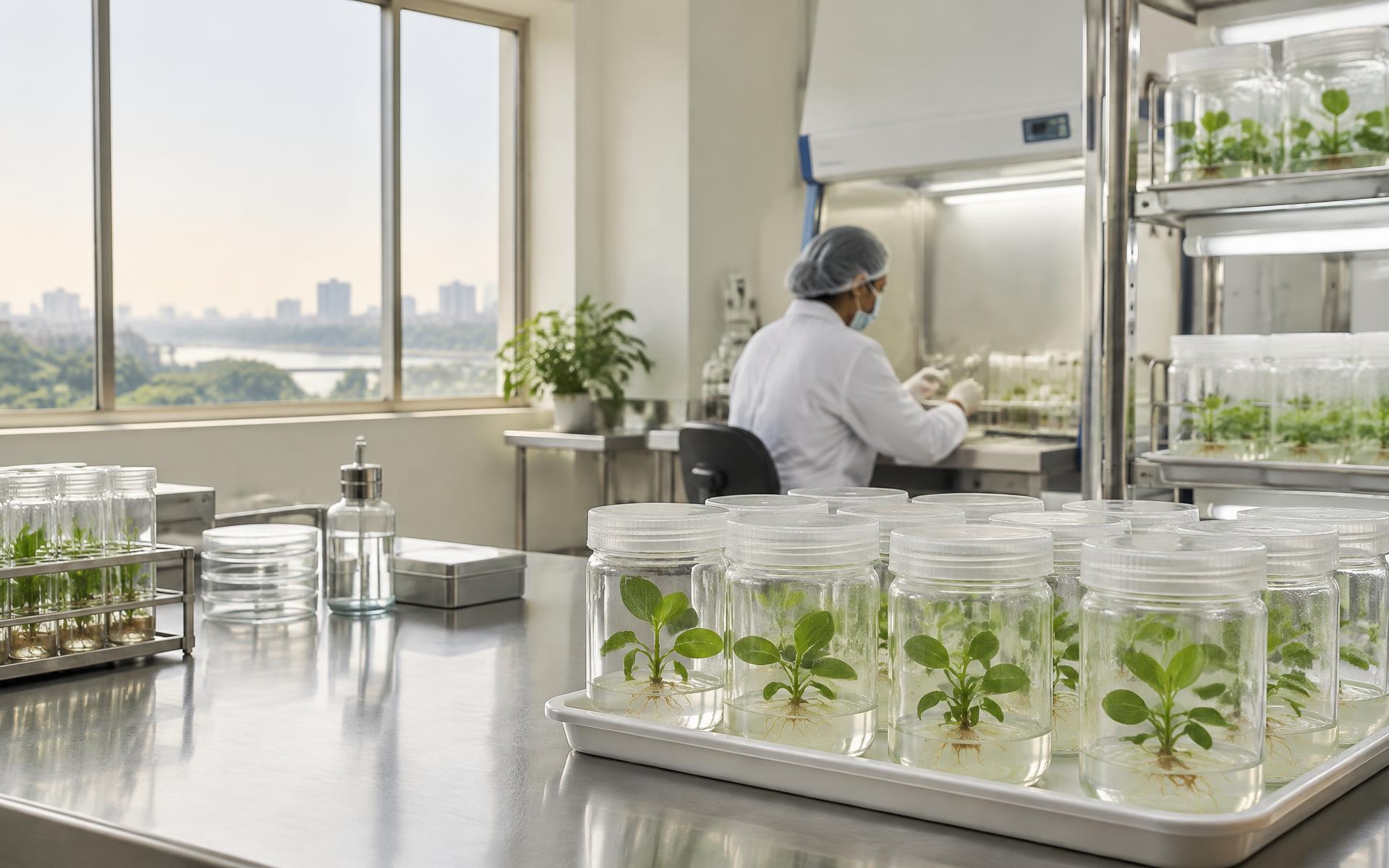
Better plants begin at the cellular level.
We grow young plants in clean, controlled conditions so that every tray you receive looks, grows and performs like the last one.
Understanding tissue culture
A plant grown from a piece of a plant.
Take a tiny piece of a healthy plant — a shoot tip or a node — clean it, and set it on a jelly of nutrients, sugar and plant hormones inside a sealed vessel. Give it steady light and warmth, and it grows into a whole new plant.
Since every plantlet comes from the same parent, they all share its traits. Growers call this micropropagation: making lots of identical, disease-free young plants from one carefully chosen mother.
It is not new. Commercial labs have used it for decades wherever consistency, speed or clean stock are worth more than the low cost of seed.
How one becomes many
If each shoot gives four new shoots per subculture cycle
Illustrative only. Real multiplication rates depend on the plant and the protocol.
Uniformity
Every plantlet comes from the same selected parent, so a batch grows, flowers and finishes on roughly the same schedule.
Multiplication
One culture can be split again and again. That is far more planting material than cuttings or division could ever give you.
Space and season
Vessels sit on racks under lights, so production takes little floor area and carries on regardless of the weather outside.
Plant health
Starting from clean stock and working sterile means fewer pests and diseases get passed on to the next generation.
Where tissue culture is used
- Ornamentals and foliage
- Fruit crops
- Vegetable crops
- Plantation crops
- Forestry and agroforestry
- Medicinal and aromatic plants
- Research and breeding
What it takes to do it well
Most failures in a lab are not dramatic. A spore gets in, a batch of medium is off, or plantlets dry out on their first day in the tray. Good practice is about closing those gaps.
Sterile technique
Laminar flow hoods, autoclaved tools and disciplined habits. One slip can cost a whole rack.
Consistent media
Nutrients and hormones weighed and mixed the same way every time, so cultures behave predictably.
Controlled environment
Light, temperature and humidity held in a tight band. Plants respond to steadiness.
Careful hardening
Leaving the vessel is the riskiest moment. Slow, humid transitions decide how many plants make it.
Typical growth-room targets
Temperature
24–26 °C
Light cycle
16 h on / 8 h off
Humidity at hardening
High, lowered gradually
Our capability
A controlled path from culture to confident growth.
Sterile micropropagation
Clean starts and repeatable multiplication cycles, logged batch by batch so we know what works.
In-vitro development
Shoots and roots developed under steady light and temperature, so plantlets come out even and strong.
Acclimatisation
A gradual move from vessel to tray. We lower humidity slowly to cut transplant shock.
B2B supply
Graded, well-rooted young plants for nurseries, growers, resellers and propagation partners.
The process
Precision at every transition.
Six stages, from mother plant to shipped tray. Tap any step to see what happens there and what we look for before a plant moves on.
Select
We start with a healthy, vigorous mother plant. Everything downstream inherits its quality, so this is where we are most selective.
What we check · Vigour, true-to-type traits, visible health
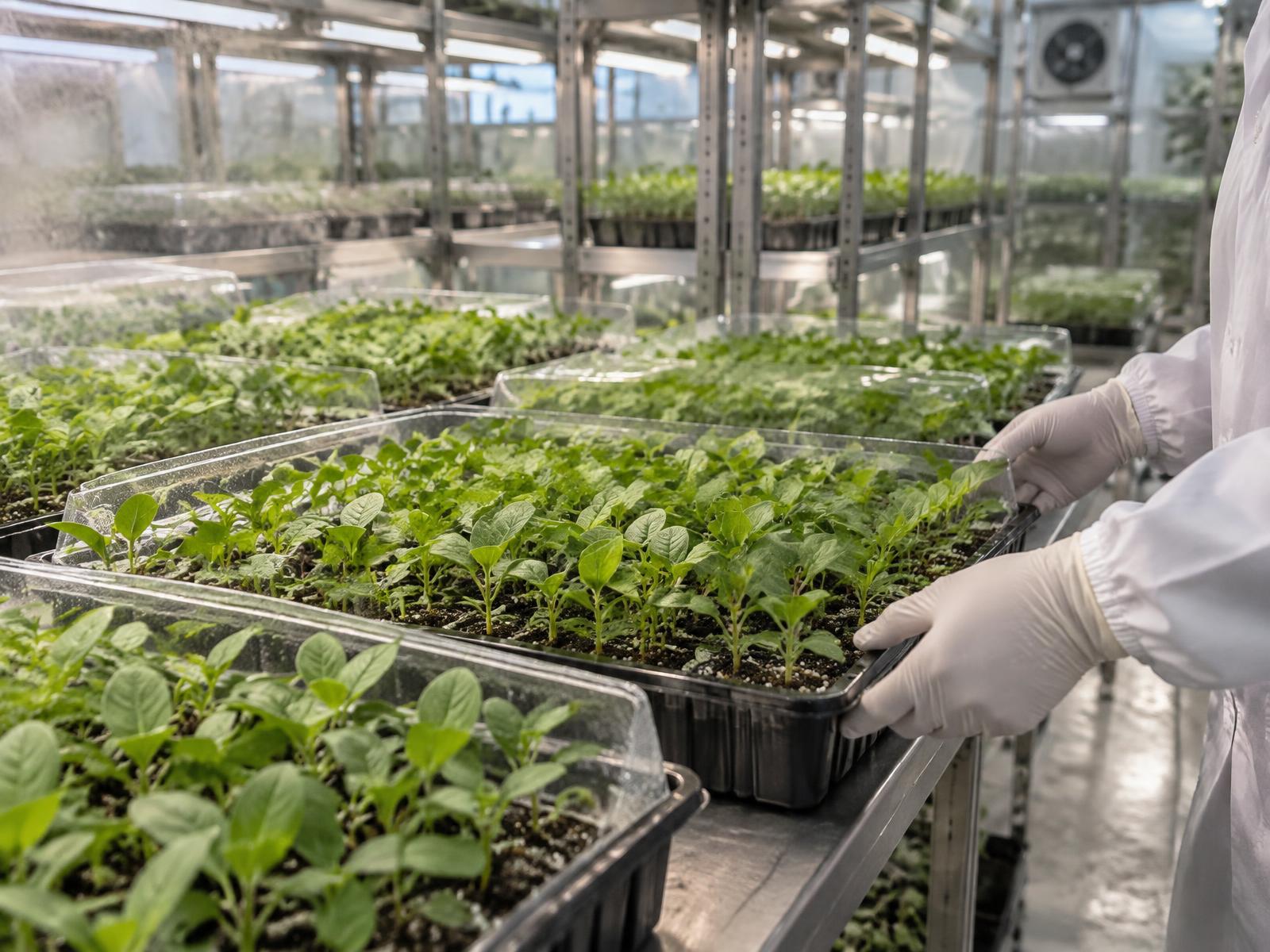
Built for dependable scale
Compact systems. Meaningful capacity.
Our planned facility in East India keeps the culture room and the hardening area under one roof. Fewer handovers, less handling, and a clear view of every batch from start to dispatch.
From the journal
Notes from the culture room.
Short guides on how tissue culture actually works — the methods, the media, and the small habits that keep a jar alive.
Who we work with
Nurseries & growers
Even, rooted stock you can pot on straight away.
Resellers & distributors
Reliable volumes and consistent grading.
Propagation partners
Shared protocols and contract multiplication.
Strategic investors
An early seat in a lean, scalable operation.
Let’s grow something repeatable.
If you buy young plants in volume, want a propagation partner, or are curious about backing a focused lab, we would like to hear from you early.